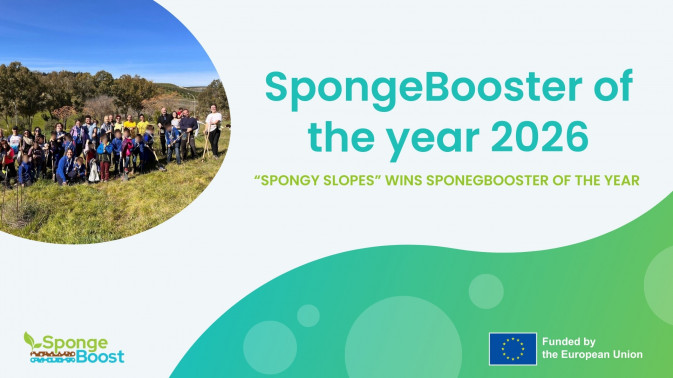
Community-driven restoration in Spain recognised as best-practice example
This press release has been published by EurekAlert! and AlphaGalileo.
“SpongeBooster of the year 2026” awarded to “Spongy Slopes”
Over recent centuries, the intensification of land use has led to the loss of natural sponge functions in many European landscapes. Changes such as soil sealing, erosion-prone land management and rapid surface runoff reduce the ability of landscapes to retain water, increase flood risks and aggravate drought impacts. Restoring sponge landscapes is therefore a key measure to address both the climate and biodiversity crises.
The SpongeBoost project supports policy-making, restoration and land-use planning by promoting cost-effective, nature-based solutions that strengthen water retention in landscapes and align with the EU Climate Adaptation goals. With the establishment of the “SpongeBooster of the year” award, SpongeBoost recognises outstanding initiatives that actively restore and support sponge landscapes and inspire others through implementation, communication, environmental education and cooperation.
“It is a pleasure for us, as the SpongeBoost project team, to once again recognise committed practitioners and to use our reach to support and amplify their work. By highlighting projects such as Spongy Slopes, we aim to inspire others and strengthen and encourage the momentum for sponge landscape restoration across Europe.”
— Mathias Scholz
UFZ, project coordinator of the EU SpongeBoost project —
After evaluating this year’s submissions, the Spanish initiative "Sponge Slopes" was selected as the winner of the SpongeBooster of the year 2026, developed with the participation of Asociación Amigos de la Cornisa Este del Aljarafe, Sevilla Más Verde and Colinas de Camas Association.
The project is located on two steep slopes within the municipal public park Parque de Santa Brígida in Camas, near Seville. Previously, these slopes suffered from severe erosion, rapid surface runoff, poor soils and very low biodiversity. Through the implementation of nature-based measures such as infiltration trenches, direct seeding of native Mediterranean tree species, soil improvement techniques and erosion control, the project has successfully restored key sponge functions in the landscape.
As a result, rainwater is now retained and released more slowly, erosion has been reduced, and biodiversity has increased significantly. Native trees and shrubs have been re-established, birds have returned to the area, and the slopes have become more attractive and resilient green spaces for local communities.
The project was initiated in 2017 by the Colinas de Camas Association, with the participation of local volunteer residents who have been continuously working on the reforestation and soil improvement of the park.
“Spongy Slopes shows the power of community-driven action. Around 250 volunteers, together with local associations and the municipal administration, have actively shaped and maintained the project. It demonstrates that small-scale, low-cost measures on slopes can deliver meaningful sponge effects beyond riverbanks and significantly improve landscape-level hydrological resilience.”
— Carina Darmstadt, Environmental Action Germany (DUH) —
By awarding Spongy Slopes this year, the SpongeBoost project highlights how local initiatives can deliver tangible ecological benefits and advance climate adaptation through nature-based solutions.
The “SpongeBooster of the year” award celebrates projects that make sponge landscape restoration visible, understandable and replicable — and Spongy Slopes stands as a strong example of how local action can drive meaningful change.
Looking ahead, the “SpongeBooster of the year” award will return in 2026. The next application round will open in fall 2026, again under the coordination of DUH. The project’s team looks forward to getting to know more inspiring and pioneering projects throughout Europe.